
3M vs Tesla vs Apple: Only one will win!

Updated: Aug 16, 2023

Welcome to the Product Moment blog. Today you will learn more about the innovation methods of three long-term successful companies and inventors. We will explore their investment styles, corporate structures, cultural elements, methods for ensuring innovation, and even the leadership core elements and tactics to be successful.

Ever wonder why some companies keep knocking it out of the park? Well, it isn’t luck like some may think. Today, let’s dig into how three companies (3M, Apple, and Tesla) do it. We will compare their innovation investment styles, corporate structures, and experimental methods.
If you have ever worked in the corporate grind, you may be thinking big companies do not innovate. They are too large and have lost the ability to truly innovate. You may also be thinking big companies are all the same. If you want to be an innovator you have to go to startup. Finally, big companies have layers of management, planning cycles, and are not agile. When you dig a bit deeper you will see there are several truly innovative companies that have different methods and structures. There are some key principles behind their success, but the how of their operating model for innovation is drastically different, yet they continue to launch and push the envelop of product innovation. How?

3M is consistently ranked in the top 20 of Forbes, America’s Most Admired Corporations. They have had 20-year long runs where their gross margin averages 51%. Recently I evaluated the knowledge of friends and family around 3M. I would lead a conversation and ask some questions like “When you think of innovative companies who comes to mind?" Apple, Tesla, Google, Microsoft, are always at the top of the list. Then I would say "What about 3M?" “What? No!”, is always the reply. Followed by “Don’t they make post-it notes?” I then start listing all the things their products are a part of or other products they know about, and they start to understand.

3M has received the US government’s highest award for innovation, the National Medal of Technology.
But how do they do it? How can you be silently in the background making 51% gross margins and win national awards? Come with me on a little journey and you will find out.
First, 3M defines present and future focus, in other words, they declare their zone split - transformation, incubation, productivity, and performance (I will teach on this next). They support the zone split by identifying their investment horizon and adjusting metrics and incentives for their long and short term horizons based on their zone allocations. For example, quarterly results are considered important but not the main thing; staying relevant is also important but cannot impact current performance. This creates balance and healthy tension and allows for a challenge their people can overcome. 3M has several mechanisms to sustain this tension. One method is employing the, 30% rule. 30% of each division’s revenues must come from products introduced in the last four years. Now you can see they have strong grasp of their investment horizons and encourage horizon three for placing future bets. When you operate in this model you then plan for the future and allocate growth capacity, you can track progress and set your employee bonuses based on successful achievements while realizing how they are performing on the J-Curve within a specified zone and while operating within a known investment horizon. 3M uses a modified investment horizon or three-tiered research structure.
Each research area has a unique focus:
· Near-Term Products -> Business Unit Laboratories focused on specific markets.
· 3-to-10 Year -> Sector Laboratories focused on product applications.
· 10-20 Year -> Corporate Laboratories focused on basic research.
Defining your horizon chart and allocation is not enough. You need to establish the entire support structure for innovation and encourage and empower inventors. How do they do this?
First off, you can request investment or support for ideas in many ways:

Seed Capital: Inventors can request seed capital from their business unit managers; if their request is denied, they can seek funding from other business units.

Genesis Grant: Corporate funding for inventors. (The Post-it innovation was funded by a Genesis Grant.) No its not a cool grant for all the retro gaming consoles you ever dreamed of. If it was I would be working there now! ;0)
New Ventures: If you are a product inventor you must recruit your own team. This reminds me of the Agile self forming team model. I think of this as a kind of speed dating round that happens inside the company. Inventors reach out to the many networking forums to find the right people for the challenge, but on the flip side, the recruits have a chance to evaluate the inventor’s track record before signing up. The pressure is lifted a bit though because if the product fails, everyone is guaranteed their previous jobs.

You don’t have to screw up to move up or be a manager to be held in the highest regard. Dual-career paths are clearly established where Scientists can continue to move up the ladder without becoming managers. They have the same prestige, compensation, and perks as corporate management. As a result, 3M doesn’t lose good scientists and engineers only to gain poor managers; a common problem in the manufacturing sector. Keep this in mind when we talk about Apple as this will be a recurring theme at successful companies.
3M has created measurement and reward systems that tolerate mistakes and encourage success. 3M rewards successful innovators in a variety of ways:

The Carlton Society, named after former company president Richard P. Carlton, honors top 3M scientists who develop innovative new products and contribute to the company’s culture of innovation.

The Golden Step cash award. This award is given if a new product is launched and reaches a revenue goal of $2 million in the U.S. or $4 million worldwide.

3M uses a research and development focus and a “15% rule” where 3M engineers and scientists can spend up to 15% of their time pursuing projects of their own choice, free to look for unexpected, unscripted opportunities, for breakthrough innovations that have the potential to expand the pie. 3M spends approximately 6% of sales on research and development, far more than a typical manufacturing company. According to surveys from Chief Executive Research, only 1.25% is the average investment for 90% of all manufacturing companies.
By leaning into innovation, enabling paths to break out and invest in new opportunities, and encourage expertise growth equally with management growth they have created an entrepreneurial, deep skilled culture that continues year after year to perform.
Note: The trend of placing innovation emphasis with your deep skilled employees while empowering them time and resources will be a common theme in this blog. Watch for it!
Foundational Knowledge Break
Now let's take a moment and build a little foundational knowledge.

I have used some terms in the blog (Zones, J-Curves, and investment horizons for example) let's dig into the meaning and application of these terms now. In 2015, Geoffrey Moore captured some of these necessary points of understanding that will help draw some correlations and solidify the concepts as we proceed.
The key principles of Zone to Win comprise understanding the reality of your performance while you are innovating or transforming. As transformers and innovators, we expect investment to equal performance increase. What actually happens is performance drops significantly for a time and you eventually reach the VoD (valley of despair) inflection point as shown in this J-Curve chart.

The people leading and delivering transformation operating in this part of the curve are either rejected or sustained by the company. This can have long lasting effects to the company’s culture and mindset for innovation tolerance. The book highlights the key element of intentionally preparing for innovation, sheltering the team from traditional operating norms, and supporting them when they are in the valley of despair. You may ask how do you shelter a team, really? Isn’t this when luck or talent comes in to save the day?

NO. You must be intentional before the VoD by clearly defining, supporting, and incentivizing the teams while they work on transformation. On the quad chart these are zones 1-3 of change. Teams must have their reward structures change and the definition of success must be defined differently than the core operating model (Productivity Zone items). This ability to support these teams is inversely proportional to the size of a company. In other words, the bigger you are, if you do not have this in place already, the harder it will be because all of your rewards and performance goals revolve around your core product line performance. In this quad-chart, most companies focus on the lower right, the Productivity Zone. The also place the burden of the Productivity Zone's performance expectations on transformative teams.

Digging a little deeper. Define and communicate the investment cascade in which the teams operate along the transformation maturity vector. Keep in mind which type of investment horizon category your teams are operating in and identify the teams that are outside the normal operating core product line deliverables. Do not hold them accountable to the core business performance metrics. This will never be achievable; their J-curve is different than the core.

It is a bit more complex, but I am going to talk just a little bit more about it and move on to the reason for this blog. The foundation needs to be here for you to see some of the patterns across the three companies.
Build capacity in your organization to be transformative and allow for innovation. This is another key principle of the Zone to Win method. One core thing that McKinsey describes in this article is how to continuously improve the organization and to allow for this capacity. They use the term Accelerated Performance Transformation (APT) to drive EBITDA expansion. Applying APT methods you can potentially improve EBITDA by more than 500 basis points in the first year alone. In the article they describe a three-step APT process based on an analysis of more than 650 industrial, technology, and consumer companies over the past two decades. By focusing on this APT method, you create headroom in your company allowing for capacity planning and innovation bandwidth.

Now let's dive into a different model. I am not sure how you feel about Elon and Tesla, but his actions are not random. I learned a lot to the approach of Tesla and Elon while doing the research for this blog.
It is hard to think of Tesla without Elon. There are many good people there too and a lot of innovation even before Elon, but in this blog we will focus on how Elon and Tesla are not launching product but transforming an industry.
Think back to 2003 when Martin Eberhard and Marc Tarpenning were building a better and

more fun to drive electric vehicle (EV). Looking back now, this seems crazy that in 2003 when hand tools barely had lithium batteries that these two were trying to build an electric roadster! Things have significantly changed over the years at Tesla, but the core innovation pattern has remained consistent. Let's dive in...
This is a bit harder to describe and differentiate the company from the leader. Unlike 3M there is a strong voice of the CEO present in the market in this model. The model is also focused on transforming and industry not necessarily delivering many products that silently drive robust growth and revenue across a diverse portfolio. So, I will transition in and out of the company and the leader specifically, Elon Musk, here so hopefully it is not too confusing.
Two core motions can be observed consistently over time with Tesla's CEO, Elon Musk.
Headline Grabbing Moves and Placing Big Bets on Core Products.
Headline Grabbing Moves:
Remember when the the first Tweets of the Cybertruck were being teased?
Here is an example of Headline Grabbing Moves by Elon:

The concept here is to formulate your innovation in a way that seems almost impossible to currently deliver. Stretch the minds of others and create a glimpse of a better world and a nugget of "If you could pull this off that would be very cool." The other side of the coin is, you don't want to exaggerate and lie and then not deliver.

Read the center Tweet above "Cybertruck will be waterproof enough to serve briefly as a boat..." Umm Wow.. see what I mean? Now we all know Jezza proved this possible when crossing the Channel to France, but hey it's a cool feature ;0)
Placing Big Bets on Core Products:
The bets form the product roadmap that incrementally deliver proof of your vision to transform the world. As each point on the roadmap becomes real so does the reality of your original vision.
For Tesla this was the roadmap for shifting the automotive industry across the world to electric vehicles. Doing things differently in the automotive market is extremely hard and this was a fundamental shift globally with many significant product and ecosystem constraints.
Models S, 3, X, and Y are the product roadmap elements that created practical examples of EVs becoming viable at a time when these were the cars being offered 2009:

Tesla was placing a big bet on this:

The 2009 Frankfurt Autoshow Model S. (Image from Wikipedia))

The 2012 Production S.
According to IHS Automotive data, the S disrupted the luxury car market and attracted buyers from the likes of BMW, Mercedes, and Lexus, as well as volume brands like Toyota and others.
To do this they placed big bets on changing the norms of the supply chain and even open sourcing their intellectual property to enable battery technologies and charging grids to mature at a much faster rate to drive down costs, increase range, and establish the necessary charging grid. They also diverged from traditional outsourced and 3rd party supply chains to develop their technologies in-house. Instead of leveraging Tier 1 Suppliers significantly. This allowed them to own their bill of materials at the component level to control costs. This yielded direct control of the supply chain for the finished product. This is vastly different that all OEMs.
You do not pull this off at the pace of Tesla without deep skills and expertise all the way at the top of the decision matrix. Sound familiar from the previous company? You will see it again before the article is done. Deep skills and expertise are not just within the engineering function, but also include supply chain specialists, finance, product and user experience, and engineering.
So how do we all leverage the methods of Headline Grabbing News and Place Big Bets in Core products? Well, to start to understand this I will use a clever term coined by Harvard Business Review (HBR). They describe this as "Innovation Capital". This is basically the innovator's ability to actually deliver on their idea.
Innovation Capital is comprised of:
Who you are
Who you know
What you've done
Who you are: This is your capacity for forward thinking, creative problem-solving, and persuasion. Have you shown you can think abstractly? Future cast? Describe the art of the possible while others have no clue, they even need what you are suggesting?
Who you know: These are your social connections with people who have valuable resources for innovation. Can you pull together a team or support network that enables you to push these novel ways of thinking to reality? Do you know your limitations, but have the connections to fill the gaps in your skills and talents?
What you've done: This is your track record and reputation for innovation. The things you do or have done to generate attention and credibility for yourself.
As business leaders your ideas, network of colleagues to help, and your accomplishments are your innovation capital and can attract the resources needed for innovation to flourish.
Impression Amplifiers:
So, you have a cool idea. You know some people. You have done this before. There is more to it. The magic of Elon and many other successful inventors/founders includes creating what HBR calls an "Innovative Reality Moment". This is when you go beyond vision casting and talking about ideas and you ground the idea in reality. You cross the chasm of dreams by making them materially viable and believable for the consumer and investor.
Take for example the Cybertruck unveiling. Many concepts that were described through vision casting were grounded in reality (hardened exoskeleton, the actual Cybertruck concept vehicle driving onto the stage, the bed storage with loading ramp, and even the "failed" glass example.

Hitting the hardened metal "exoskeleton" with a sledgehammer at the Cybertruck unveiling.
There is momentum over time that is created in the market too. HBR calls this Reputational Success Comparison. Think of this as how your track record competes in markets where the rates of technological change and disruption are high.

Leaders and individual contributors need deep skills and understanding of the technologies responsible for disruption. You may be so far out in front you cannot acquire market feedback or create solid market forecasts. So, the company must Place Big Bets about which technologies and designs are likely to succeed and it is critical to rely on technical and deep skilled experts rather than general managers increases the odds that those bets will pay off. <--- Ding, Ding, Ding.... Wakeup again and pay attention here...
The Whole Vision and Core:
Casting the vision to transform the industry. Showing progress by launching products that instill confidence that this transformation could actually happen. When you are pushing the edge of design and have breakthroughs but realize that sharing this knowledge will actually accelerate the entire ecosystem you depend on, you can share the IP and redefine the industry. Early transformation sharing of battery design, charging standards, software architecture, as well as vehicle hardware allowed the industry to look inside of the innovation at Tesla and think differently while having confidence by seeing products come to market. This did two things: 1) Grounded their reality even more and the investors, employees, and buyers all felt like Tesla would be successful. 2) Enabled an amplifier in the industry to create partnering without contractual agreements. In other words they had a lot of help building the vision without having to acquire or legally partner. Their much needed ecosystem began to transform and grow organically. By leveraging innovation capital, traditional product architectures were challenged and transformed, accepted bottlenecks were addressed in non-traditional ways, and sharing their knowledge helped resolve system-level limitations and increase adoption of technologies. All of these added up to an effective approach to win the resources and support to necessary to execute the transformative vision in its entirety.

Apple. I have to be honest when I first researched Apple I thought I would find a company like many others that has just been lucky or "Standing on the shoulders of giants." I remember when I first heard Steve Jobs had passed and thinking they might not have a strong future now or could they keep innovating? As I investigated the company's structure I began to realize that changes Steve championed in 1998 made a significant impact to the future trajectory of Apple. Not just the products they launched but the core shift they made in culture, structure, and operations. I also realized that this is the same year that Tim Cook was hired. He was part of this fundamental first order change.
Apple is a Functional Organization. This differs from the more common decentralized business units operating with their own P&L responsibility.
What is a functionally structured company? It starts with how the most senior leadership is defined. Senior Vice Presidents are responsible for functions across the company (SVP of Hardware, SVP AI and ML, SVP of Operations...). Here is an example of Apple's functional structure (Marketing, Engineering, Operations, etc.):
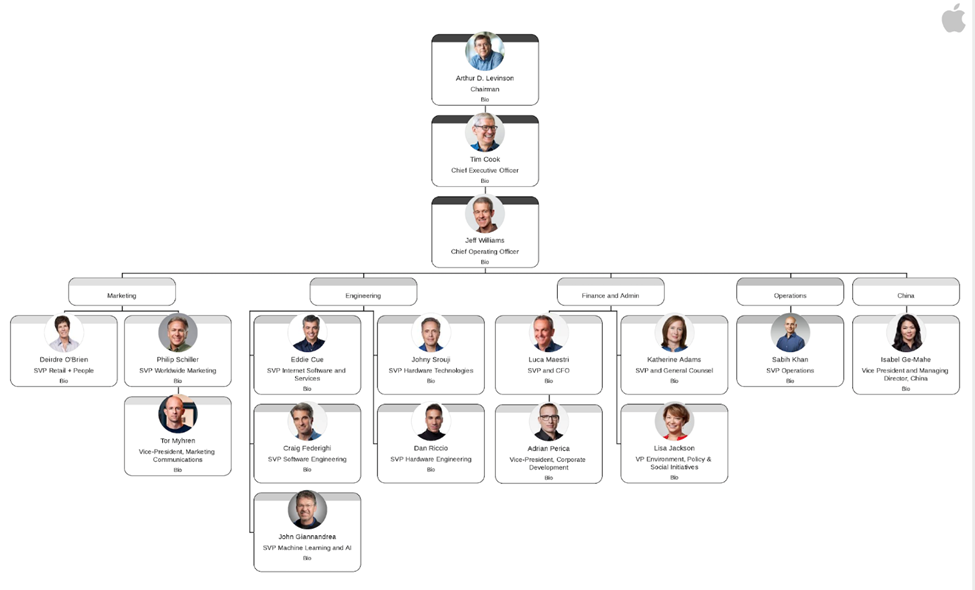
Large companies are not typically organized this way. They are multidivisional. The thought behind the tradition multidivisional structure is to enable accountability and control to meet the needs of customers that align to the individual business units.
The diagram below shows a traditional multi-divisional structure.

Now read this quote from Steve Jobs about the reorg.

“We went through that stage in Apple where we went out and thought, Oh, we’re gonna be a big company, let’s hire professional management. We went out and hired a bunch of professional management. It didn’t work at all….They knew how to manage, but they didn’t know how to do anything. If you’re a great person, why do you want to work for somebody you can’t learn anything from? And you know what’s interesting? You know who the best managers are? They are the great individual contributors who never, ever want to be a manager but decide they have to be…because no one else is going to…do as good a job. ”
Apple is not a company where general managers oversee managers, it is a company where experts lead experts. There it is again for the third time in this blog. Expertise is highly valued and allowed and expected to lead in the organization.
Let's look at the definition of an expert. An expert is somebody who has a broad and deep understanding and competence in terms of knowledge, skill, and experience through practice and education in a particular field or area of study. It's not the more senior engineer or the leader of product, it could be but, time and position or authority do not equal expert. In the Apple model, being a leader means you are an expert and you moved towards leading because you wanted to enable others to be experts and do amazing things with your expertise. The core assumption at Apple is that it’s easier to train an expert to manage well than to train a manager to be an expert.
Back in 1998 the first organizational shift to a functional structure looked like this. It was a big change and lots of leadership were asked to leave during that change.

1998 First Organizational Restructure to be Functionally Focused.
Competing in consumer electronics and services is very challenging with lots of competition. Creating new categories in this area is extremely hard and rare. Apple’s innovation model is two pronged creating new categories and also through continuous improvement. To aggressively compete in this market the leaders must have deep expertise, understanding of details, and be a collaborative active participant of the decision-making triad of desirable, feasible, and viable. SVPs must possess three key leadership characteristics: deep expertise that allows them to meaningfully engage in all the work being done within their individual functions; immersion in the details of those functions; and a willingness to collaboratively debate other functions during collective decision-making.
Innovation Capital and Impression Amplifier History at Apple:
In the era of Steve Jobs he did operate a little like the model we discussed with Tesla and Elon Musk. He would regularly leverage his innovation capital and use impression amplifiers to gather support, excite the market for a new category, and ground a vision in reality through demos that were thought to be unachievable.

Focus on the Long Game:
Okay so the company's structure is functionally organized, but how does that translate to innovation? The financial performance is tied to the company's whole performance, creating a feeling of "We are all in this together." Furthermore, product decisions are insulated from short-term financial pressures and the finance team is not involved in the product road map meetings and engineering teams are not involved in pricing decisions. This creates a culture of innovation and exploration and some time to explore product market fit while allowing for market adoption before reacting through financial performance in the short-term.
There is a core cultural element at Apple that is focused on the user and their experience in the ecosystem while considering the product's entirety. Cost is not the number one factor. The product is not isolated from the mission or the other products that are part of the ecosystem.

There is the story around the iPhone 7 plus release which included the first dual camera. Portrait mode was now available with two cameras which enabled the fuzzy background (Bokeh) effect and the hardware and firmware would not allow preview before capture. The user experience function team desired this preview to be in place before launching the feature because it was part of their experience with other products. To have preview before capture was standard and created the best experience, but this feature would cause a portrait mode delay of a full year. This would never happen in other companies that are multidivisional. Cost would drive the decision and the feature would launch. You could argue is perfection the enemy of progress in this instance? But I would remind you that this type of approach has led them to innovate beyond expectation over and over again and has allowed them to create new product categories by pushing themselves to perfection. It is a balance, but when you are equipped with experts as leaders you can weigh these tradeoffs and push the envelope together.
So, what happens when you place a big bet and you are wrong? On the flip side, due to the highly visible and collaborative nature across functions at Apple, a person's and team's reputation highly valued. If you make a major mistake in market, your next shot wont be as easy as the last one. This healthy pressure is reputational accountability.
Why have all these experts as leaders? Leaders should know the details of their organization at least three levels down in order to make fast and effective cross-functional decisions. It is not uncommon for leaders to attend a decision-making meeting and if the presenter or team are not prepared the decision will be postponed. Sr. Leaders will dive deeply into design elements, lines of code, or even database elements in these meetings. This is not micromanagement, but deep expertise in action. A leader sees something and intuition tells them this is not quite right, the leader leaps into action, digging in with the team to figure it out. The result is a problem avoided and a better product launched.
A leader’s ability to be champion while keeping an open-mind to alternatives is shown through two actions: 1) A deep understanding and devotion to the company’s values and common purpose. 2) A commitment to separating the right path from the difficulty of executing the path when making a decision.
Discretionary Leadership Model
Apple has also introduced a discretionary leadership model. The purpose of this is to drive innovation in all areas of the company, not just product development, and to increase the scale of innovation.
How do they do this? Leaders from the Director level up go through training to teach them how to exercise greater discretion regarding where and how they spend their time and efforts. Leaders must understand what activities create the highest value for Apple. Then they must decide where to place their full attention to detail on these valuable activities. They then decided their core expertise. They map these expertise to core items they own and items they need to learn. The highly collaborative nature of leaders and teams at Apple an also makes learning gaps more visible. The allows for other leaders to step up and teach to help fill the gaps across the organization. The items that are not part of the leader's expertise are identified and delegated to create opportunity for others to lead and grow.

Ever work at a company where leadership cannot prioritize? WIP (work in progress) is too high or management is just not engaged or is just asking their teams for advice on what is important?
The expert driven, discretionary leadership model inside a functional organization address this:
1) Experts are leaders and high collaboration with deep skills are employed at all levels enabling fast decision making, doing hard things that are thought to be impossible, and continuous upskilling through skilled interactions.
2) People with years of experience in the direct area of responsibility are leading at the top offering historical expertise, but transparent reputational accountability; ensuring building it right over "its too hard to do that" is always the outcome.
3) Clear boundaries of focus are declared and understood as well as your expertise core and gaps for learning. It is not a matter of less important vs more important it is about knowing your strengths and weaknesses and focusing on your strengths, growing in your gaps of expertise, and depending on others to cover the areas of low expertise through agreed delegation.
The discretionary leadership model aligns expertise and decision rights and creates an effective functional organization. Leaders can learn and take on new responsibilities outside their original expertise while teams grow as leaders teach others their craft and delegate work.
My Takeaway From This Research:
In the book "Outliers" Malcolm Gladwell talks about the 10,000 hour "rule".

“Practice isn’t the thing you do once you’re good. It’s the thing you do that makes you
good.” The book “Outliers: The Story of Success” by Malcolm Gladwell
Think about this for a minute: 10000 hours / 4 hours a day = 2500 days. 2500 days / ~229 working days in a year = 10.9 years. Then think about the innovation models we looked at and you will start to see why all three models embrace expertise in leadership. To create something innovative or uniquely valued it should take expertise. You are delivering something that is not available, not on anyone's radar, or it is considered unachievable. Whether it is chemical and material products, rockets and cyber trucks, hand held music libraries and high performance compute and connectivity in the palm of your hand they all require deep expertise to bring these to market.
Today, look around your company.
Are you enabling expertise to be elevated and supported to the highest levels of leadership?
Do you have the right investment strategies to support innovation?
Are the reward structures and bonus incentives enabling continuous improvement and innovation?
Are you shielding your teams when they are in the valley of despair?
Can your leaders prioritize based on their expertise and delegate to enable growth of other leaders and teams?
Can the innovative people in the company ask for a team or funding to chase a dream without fear of persecution?
If not, think about real changes you can make and look to these long running models of success to see how you can make a difference.

One last thing. I have been reading a lot of the animal vs animal books with my kids so I have to confess I may have gotten carried away with my title. ;0)
Now go out and try these techniques and make a difference!


Comments